Leucospermum Flagstaff Red
March 11, 2025
Alocasia Frydek Variegata
March 17, 2025

Brighamia insignis – Hawaiian Palm
| Min Temp : | +15° |
| Pitch: | Sunny / Partial shade |
| Water requirements : | Medium to low |
| Flowering period : | Summer |
| Scented : | No |
| Edible: | No |
| Use: | Houseplant |
| Evergreen: | Yes |
| Height: | 50cm and more |
€19.95
The Brighamia insignis, also known as the Hawaiian palm or volcano palm, is a rare and unique plant endemic to the Hawaiian Islands.
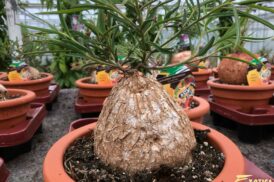
The Brighamia insignis has a thick, fleshy trunk that resembles that of a palm tree, hence the nickname “Hawaiian palm”. The plant has no true branches, but produces a rosette of large, fleshy leaves at the top of the trunk.
The plant produces fragrant, trumpet-shaped flowers that are usually yellow or white. The flowers grow in clusters and usually bloom in the fall.
The plant can reach a height of 1 to 2 meters.
The Brighamia insignis is native to the Hawaiian Islands, particularly Kauaʻi and Niʻihau. It usually grows on steep cliffs and rocky areas.
The plant is considered critically endangered in the wild, mainly due to habitat loss, invasive species, and lack of natural pollinators. Efforts are being made to preserve and reintroduce the plant to its natural habitat.
The Brighamia insignis thrives in warm, tropical climates. It is not winter hardy and cannot tolerate frost.
The plant prefers well-drained, rocky or sandy soil.
Full sun to partial shade is ideal for optimal growth.
The plant requires moderate watering. It is important to allow the soil to dry out between waterings to prevent root rot.
During the growing season, the plant can benefit from a balanced, slow-release fertilizer.
Pruning is usually not necessary, except to remove dead or damaged leaves.
In the wild, the Brighamia insignis was originally pollinated by a specific species of moth that is now likely extinct. This has contributed to the plant’s decline in the wild.
Due to its rarity and unique appearance, the Brighamia insignis is sometimes grown as a houseplant or in botanical gardens. Growing this plant can be a challenge, but it is also a way to contribute to the conservation of the species.
| Weight | N/A |
|---|
Related products
-
Merremia Holobii
€31.25 -
Stephania Erecta
€39.95 -
Euphorbia Trichadenia
€49.95